
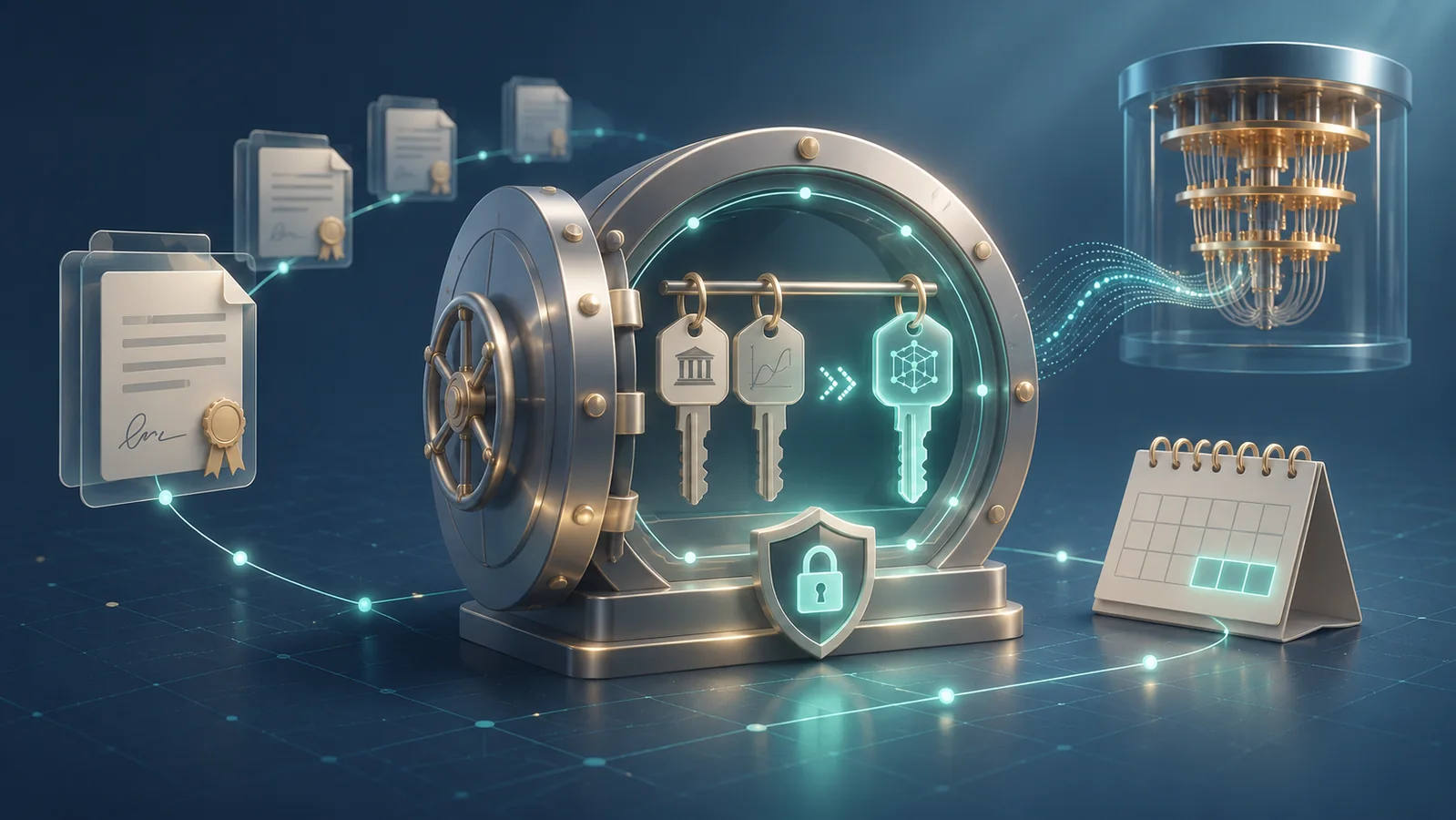
Quantum computers capable of running Shor’s algorithm could threaten RSA and elliptic-curve cryptography. Organisations need to prepare their key-management systems (KMS) for post-quantum cryptography. The transition affects certificate governance, threat modelling and regulation, and needs to be planned before 2026.
Introduction: PKI on the brink of the quantum era
In 2022, the National Institute of Standards and Technology (NIST) published the first standardised post-quantum encryption algorithms — CRYSTALS-KYBER for public-key encryption, CRYSTALS-KD for key exchange, as well as Dilithium and Falcon for digital signatures [1]. Their adoption marks the end of an era where RSA (2048 bits) and ECDSA (P-256) were considered computationally secure against classical computers.
At the same time, the private sector and public laboratories are announcing rapid advances in quantum computing: IBM presented a 433-qubit processor in 2023, and Google demonstrated an improvement in noise factor (quantum volume) to 128 [2]. Although the capacity required to break RSA-2048 is still estimated at between 4,000 and 20,000 logical qubits — remaining out of reach for now —, projections from several institutes (ENISA, ANSSI) converge towards a critical window of opportunity before 2030 [3][4].
For companies whose certificate lifespans span five to ten years, the 'latency period' between the issuance of a certificate and its expiration creates a risk of retroactive compromise. An attacker capturing an RSA-2048 public key today will be able to decrypt all past communications protected by that key as soon as quantum computers become capable.
Why 2026?
- NIST Timeline: the first version of 'NIST Special Publication 800-208 – Recommendation for Key Management' already incorporates PQC migration requirements and anticipates an official update by the end of 2025 [5].
- European Roadmap: the EU's 'Quantum-Safe Cryptography' plan sets 2026 as the target date for critical public services to have adopted at least one post-quantum algorithm within their PKI [6].
- Commercial Solution Maturity: since 2023, several providers (Thales, Entrust, DigiCert) have offered PQC-compatible HSM and KMS modules, available in 'hybrid' versions from 2024.
These milestones require CIOs, CISOs, and data governance officers to begin a progressive transformation of their PKI infrastructures immediately.
1. The quantum threat model applied to PKI
| vector | description | potential impact |
|---|---|---|
| Passive certificate capture (TLS handshake, S/MIME email) | An attacker intercepts RSA/ECDSA public keys during transmission. | Retroactive decryption as soon as a powerful quantum computer emerges. |
| Compromise of a Certificate Authority (CA) | Access to the CA's private keys or the database of issued certificates. | Ability to forge post-quantum and traditional certificates, breaking the chain of trust. |
| Injection attack in the KMS | Exploitation of a software vulnerability in the key management server to extract secrets. | Exported keys can be stored and decoded later using a quantum computer. |
The threat model is therefore evolving: traditional cryptanalysis (factoring, discrete logarithm) is giving way to quantum cryptanalysis. The exposure surface is increasing because post-quantum algorithms are not yet universally deployed and heterogeneous systems (hybrid RSA + Kyber) introduce new interfaces.
2. Technical principles of post-quantum solutions for key management
2.1 Public key encryption algorithms (KEM)
- CRYSTALS-KYBER – lattice-based, it offers reasonable public key (~800 bytes) and private key (~2400 bytes) sizes, with security equivalent to RSA-3072.
- NTRUEncrypt – a lattice-based alternative, already implemented in OpenSSL 3.0 (module provider).
These KEMs replace RSA-Encryption or ECDH within the TLS 1.3 protocol and PKI key exchanges.
2.2 Digital Signature Algorithms
- CRYSTALS-Dilithium – medium-sized signatures (~3000 bytes) with performance comparable to ECDSA.
- Falcon – more compact signatures (≈660 bytes) but higher computational requirements, suitable for constrained devices.
CAs must sign certificates using these algorithms to ensure post-quantum integrity.
2.3 Hybrid Approach
The hybrid mode combines a classical algorithm and a PQC algorithm within the same operation: the client encrypts a symmetric key using both RSA (or ECDH) and Kyber, then sends both encrypted blocks. The server decrypts both, retaining only the one that succeeds. This technique ensures service continuity as long as one of the algorithms remains invulnerable [7].
2.4 Key Storage and Protection
HSMs (Hardware Security Modules) must be updated to support new key sizes and cryptographic primitives. Vendors have released compatible firmware:
- Thales nCipher 4.x – supports Kyber-1024, Dilithium-3.
- Entrust nShield 2024 – addition of the pqc provider for OpenSSL.
The Key Management Interoperability Protocol (KMIP) 2.0 has integrated extension fields for PQC algorithms, facilitating standardisation between KMS and HSM.
3. Migration architecture: from traditional PKI to quantum-ready PKI

Read the diagram notation
graph LR
    A[CA principale] -->|Émission certif. RSA| B["RA (Registration Authority)"]
    A -->|Émission certif. PQC| C[CA post‑quantum]
    B --> D["HSM legacy (RSA/ECDSA)"]
    C --> E["HSM quantum‑ready (Kyber/Dilithium)"]
    subgraph KMS
        D
        E
    end
    F[Applications] -->|TLS hybride| G[Load Balancer]
    G --> A
G --> C- Creation of a post-quantum CA: a distinct authority that signs certificates using Dilithium or Falcon, while maintaining the same trust hierarchy (root, intermediates).
- Deployment of a quantum-ready HSM: firmware update or acquisition of a new module capable of generating and storing larger keys.
- Implementation of a hybrid gateway: the TLS server exposes two cryptographic suites (e.g., TLS_AES_256_GCM_SHA384 + Kyber1024) via ALPN negotiation. Compatible clients select the strongest suite, while legacy clients remain on RSA/ECDSA.
- Database synchronisation: the Certificate Management System (CMS) must simultaneously store classical and post-quantum algorithms within the same subjectPublicKeyInfo field. The X.509 format was extended in 2022 to accept PQC OIDs [8].
- Lifecycle management: each certificate has two expiry dates – a 'classical' one (5 years) and a 'post-quantum' one (10 years). Key rotation is performed in parallel to avoid service disruptions.
4. Use case: migration of a European bank to a quantum-ready PKI
Context – Bank X, a pan-European operator with over 30,000 TLS servers and a portfolio of RSA-2048 certificates with an average lifespan of 7 years. Management has set a target to reduce the risk of retrospective compromise to < 5% by 2026.
| Step | Action | Result |
|---|---|---|
| Audit (Q1 2023) | Certificate inventory, identification of application dependencies, HSM support assessment. | 12,500 RSA-2048 certificates, 2,300 ECDSA-P256 certificates. |
| Proof of Concept (Q2-Q3 2023) | Deployment of a test server with OpenSSL 3.0 + pqc provider, generation of Dilithium-5 and Kyber-1024 certificates. | Validation of handshake time < 10% higher than RSA/ECDSA, no functional regression. |
| HSM Update (Q4 2023) | Installation of two nShield 2024 with PQC firmware, migration of master keys to Kyber-1024/Dilithium-5. | Storage capacity increased by 30% for public keys. |
| Hybrid Deployment (H1 2024) | Activation of hybrid TLS mode on web front-ends; modern clients use Kyber, legacy clients remain on RSA. | 68% of traffic uses the post-quantum suite after 3 months. |
| Creation of the PQC CA (Q2 2024) | New sub-CA signed by the existing root, 'Quantum-Ready' issuance policy. | 5,000 PQC certificates issued for critical services (payments, internal APIs). |
| Phased RSA decommissioning (2025-2026) | Overhaul of renewal policies: every certificate expiring before the end of 2026 is replaced by a hybrid dual-certificate, then PQC only. | 99% of the fleet certified in quantum-ready mode by Dec 2026. |
Lessons learned
- HSM capacity planning: post-quantum keys are up to 5 times larger than RSA; slot expansion must be anticipated.
- Legacy management: hybrid mode prevents a hard cut-off; however, some applications (e.g. IoT devices) do not yet support Kyber and require a conversion bridge.
- Governance: updating the Certificate Policy (CP) required involvement from the compliance committee (ANSSI, GDPR) to validate new OIDs.
5. Regulatory and normative challenges
| Reference | Domain | Main Requirement |
|---|---|---|
| NIST SP 800-208 (2024) | Key Management | Integrate PQC algorithm rotation into the key lifecycle. |
| ENISA – Quantum-Safe Cryptography Report (2021) | Information Security | Recommend a gradual migration before 2030, with an annual quantum risk assessment. |
| ANSSI – Guide “Post-Quantum Transition for PKI” (2023) | French Compliance | Obligation to maintain the algorithm register and ensure the traceability of PQC certificates. |
| ISO/IEC 23881 (in progress, expected 2025) | International standard | Define robustness testing requirements for PQC implementations within KMS. |
| GDPR – Art. 32 | Data protection | Justify technical security measures adapted to future threats, including the quantum factor. |
These texts converge towards an obligation of due diligence rather than a strict prohibition: organisations must demonstrate that they have assessed quantum risk and implemented a documented migration plan.
6. Operational constraints and associated costs
| Domain | Impact | Mitigation |
|---|---|---|
| Performance | Dilithium/Falcon algorithms are more CPU-intensive than ECDSA (≈ 2‑3×). | Use hybrid mode, deploy cryptographic accelerators, or migrate critical workloads to dedicated servers. |
| Storage | X.509 certificate size increases by 30 to 70% (e.g., RSA‑2048 certificate ≈ 1 KB → Dilithium‑5 ≈ 3.2 KB). | Scale LDAP/CMDB databases in anticipation of a 50% growth. |
| Interoperability | Some legacy clients (browsers < Chrome 90, Android devices < 9) do not support PQC suites. | Maintain dual hybrid certificates during the transition period or use TLS proxies that terminate the handshake in PQC mode and relay via RSA to the client. |
| HSM Cost | PQC-compatible modules are 20‑30% more expensive than legacy models. | Plan a 3-year CAPEX, leveraging firmware update programmes (e.g., Thales “Quantum Upgrade”). |
| Skills | Need to train personnel on new algorithms and the management of X.509 OIDs. | NIST-PQC certified training programme for SecOps teams, in partnership with specialised integrators. |
On average, a large enterprise (≥ 10,000 servers) can expect a total investment between €2 and €4 million over five years, including HSM licences, consulting services, and training. This figure remains lower than the potential cost of a massive breach due to the retroactive compromise of a PKI (estimated > €10M according to ANSSI) [9].
7. Points of vigilance
Technical risks
- Flaws in PQC implementations: although standardised, some libraries (e.g. liboqs‑openssl) may contain bugs that weaken security.
- Future depreciation: the NIST standardisation process is still ongoing; some algorithms may be replaced or adjusted by 2028.
Organisational risks
- Fragmentation of the certified estate: if each department adopts its own PQC algorithm, centralised management becomes difficult and increases the risk of misconfiguration.
- Regulatory non-compliance: failure to update algorithm registries may lead to sanctions during a GDPR or ANSSI audit.
Trade-offs
- Hidden costs: migration often involves updates to CI/CD pipelines, regression testing, and adaptations to application code (e.g. Java Security Provider).
- Latency impact: hybrid TLS exchanges increase handshake time by approximately 10-15 ms, which can be critical for services with