
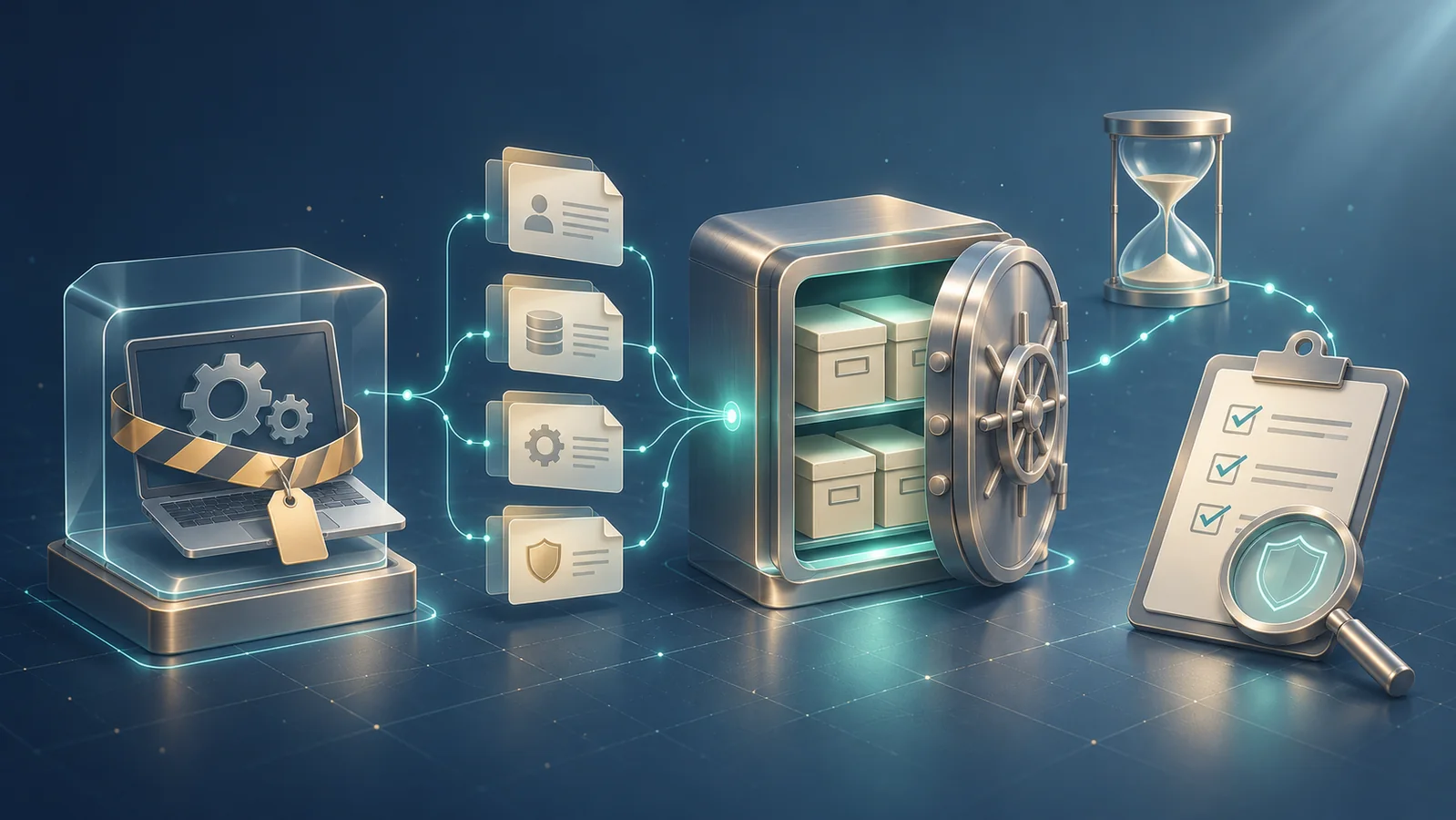
When an application or infrastructure reaches the end of its lifecycle, IT teams often remove it from service permanently: this is decommissioning. Beyond simply stopping services, this operation raises a crucial question: which data must be archived to justify compliance with legal, regulatory, or contractual requirements several years down the line? The answer involves a careful balance between retention obligations (GDPR, LPM, PCI-DSS…), auditability requirements (access logs, configurations, decisions), and operational constraints (storage costs, security, governance). The article describes the challenges, the data to retain, and a framework for managing it after decommissioning.
1. Context: Why decommissioning is becoming an audit challenge
Organisations are modernising their IT systems at a steady pace (cloud migration, adoption of micro-services, data centre rationalisation). Each project inevitably leads to the decommissioning of a legacy platform. However, compliance requirements do not vanish when a system is shut down:
- Legal Obligations – GDPR mandates a minimum retention period for personal data necessary for the purposes for which they were collected (Article 5-1 c). In France, the LPM law (Loi de programmation militaire) requires certain security traces to be retained for 10 years.
- Contractual Requirements – SLA clauses or PCI-DSS requirements mandate the retention of transaction logs for at least one year.
- Legal Risk – In the event of a dispute, the absence of archived evidence (e.g. access logs, governance decisions) can lead to financial penalties or loss of customer trust.
Consequently, decommissioning is no longer a simple technical operation: it is a critical control point for legal resilience and continuous auditability.
2. Regulatory Framework and Applicable Standards
| Domain | Reference | Minimum Retention Period* |
|---|---|---|
| Personal Data (GDPR) | Art. 5-1 c, Recital 78 | Variable depending on purpose; often 2–7 years (e.g. billing) |
| Access traces and security logs (ANSSI – “Journalisation” Guide) | ANSSI‑GS‑RC‑001 | 12 months (minimum), 24 months recommended |
| PCI‑DSS compliance evidence | PCI‑DSS v4.0, Req 10.7 | 1 year (logs) + 3 years (archives) |
| Traces related to defence or critical infrastructure (LPM) | LPM Art. 9‑2 | 10 years |
| Retention of accounting documents | Code du commerce, Art. L123-22 | 10 years |
| Internal audits and incident reports | ISO 27001, A.12.7 | 3–5 years depending on internal policy |
\*The durations indicated are the legal or sectoral minimums; internal policy may be more stringent.
These requirements often overlap: a single log file can satisfy multiple frameworks, provided it is correctly classified, integrated into a retention solution, and protected against tampering.
3. Typology of data to be archived after decommissioning
3.1 Operational data
| Category | Concrete example | Reason for archiving |
|---|---|---|
| Access logs | HTTP, SSH, VPN logs | Prove who accessed what and when – essential for forensic investigations. |
| Security event logs | Syslog, IDS/IPS alerts | Demonstrate incident detection and response during the operational period. |
| Configuration traces (CMDB) | *.conf files, infrastructure as code (IaC) scripts | Reconstruct the system state at a given date – useful for compliance or change audits. |
| Test and validation reports | Performance results, load reports | Justify that the system met functional requirements prior to its decommissioning. |
| Tickets and incidents | ServiceNow tickets, JIRA, incident tickets | Demonstrate the traceability of issues encountered and the resolutions applied. |
3.2 Legal and contractual data
- Service Level Agreements (SLA) associated with the system.
- Data Processing Agreements (DPA) signed with sub-processors.
- Governance decisions (e.g., steering committee, budget approvals).
- Internal or external audit reports conducted during the model's lifecycle.
3.3 Backup and recovery data
Even if the system is decommissioned, backups containing historical data may be required to:
- Respond to a subject access request (GDPR Art. 15).
- Reconstruct the state of an incident under investigation.
- Provide evidence of business continuity during a resilience audit.
3.4 Meta-information and indexing
A detailed archive catalogue (acting as a metadata “data lake”) facilitates future retrieval:
| Metadata | Example |
|---|---|
| Unique system identifier (UUID) | sys-2021-CRM-001 |
| Operational period | 2015‑01 → 2022‑06 |
| Type of archived data | logs, config, contracts |
| Sensitivity level | public / internal / confidential |
| Legal retention period | 7 years (GDPR) |
4. Technical architecture of a post-decommissioning archiving solution
4.1 Guiding principles
- Immutability – Archives must be read-only and protected against any unauthorised modification (e.g. WORM — Write Once Read Many).
- Verifiable integrity – Use of cryptographic hashes (SHA-256) and digital signatures to guarantee non-alteration.
- Storage security – Encryption at rest (AES-256) and in transit (TLS 1.3).
- Lifecycle management – Automated policies for retention, cold storage, and subsequent purging upon expiration.
- Controlled accessibility – Access control based on the principle of least privilege (RBAC/ABAC), with logging of archive access.
4.2 Typical diagram

Read the diagram notation
flowchart LR
    A[Sources à archiver] --> B{Pré‑traitement}
    B --> C[Normalisation & métadonnées]
    C --> D[Hachage + Signature]
    D --> E["Chiffrement (AES‑256)"]
    E --> F["Stockage WORM Cloud (ex. AWS Glacier Deep Archive, Azure Immutable Blob)"]
    F --> G["Catalogue Méta‑données (ElasticSearch / OpenSearch)"]
    G --> H[Portail d’accès contrôlé]
    H --> I[Audit & Reporting]
Cloud solutions offer native 'immutable' options (e.g. Amazon S3 Object Lock, Azure Immutable Blob Storage) which simplify compliance.
4.3 Common technological choices
| Requirement | Open-source option | SaaS option |
|---|---|---|
| Immutable storage | MinIO with WORM mode + Ceph RADOSGW | Amazon S3 Object Lock, Azure Immutable Blob, Google Cloud Archive |
| Indexing and search | OpenSearch, Elastic Stack (with ILM) | AWS OpenSearch Service, Azure Cognitive Search |
| Lifecycle management | Apache NiFi + Python scripts | Cloud native lifecycle policies (e.g. S3 Lifecycle, Azure Blob lifecycle) |
| Integrity verification | HashiCorp Vault for signatures | AWS Macie (anomaly detection) |
The choice depends on the desired level of sovereignty, archive volume, and team maturity.
5. Operational decommissioning process with audit retention
- Planning
- Identify stakeholders (CIO, CISO, DPO, legal).
- Catalogue applicable legal and contractual requirements.
- Artefact inventory
- Run an automated scan (e.g., PowerShell/CLI scripts) to list logs, databases, configurations, and contractual documents.
- Validate completeness with business teams.
- Classification & metadata
- Apply the metadata schema presented in §4.2.
- Assign a sensitivity level (public / internal / confidential).
- Pre-processing and securing
- Normalise formats (e.g., JSON for logs, YAML for IaC).
- Generate SHA-256 hash + PGP signature.
- Encrypt the stream to the archiving destination.
- Immutable storage and indexing
- Deposit artefacts into a WORM bucket configured with an appropriate retention policy.
- Populate the metadata catalogue (e.g., OpenSearch).
- Post-deployment integrity verification
- Compare hashes calculated before and after transfer.
- Document results in an archiving report.
- Communication & training
- Inform teams of archive availability (portal, access procedure).
- Train data governance officers on how to consult the archives.
- Periodic internal audit
- Verify annually that retention policies are adhered to and that archive access remains compliant.
This process can be managed by an orchestration tool (e.g., Ansible, Terraform) to ensure the reproducibility and traceability of the decommissioning.
6. Cost-benefit analysis
| Item | Estimated cost (over 5 years) | Primary benefit |
|---|---|---|
| Cloud WORM storage (e.g., 10 TB at €0.00099/GB/month) | ~ ≈ €600 | Regulatory compliance, reduction of legal risk |
| Encryption & Key Management (KMS) | ≈ €300 | Protection against sensitive data leaks |
| Implementation of a catalogue (OpenSearch) | €2,000 (SaaS licence or hosting) | Fast search, time savings during audits |
| Process automation (scripts + CI/CD) | €5,000 (initial development) | Reduction of human error, standardisation |
| Training & governance | €1,500 | Organisational adoption, improved access control |
Return on investment is primarily measured in terms of penalty prevention (GDPR fines reaching up to 4% of annual turnover) and reputational protection, which is difficult to quantify but critical for companies operating in highly regulated sectors.
7. Key points of vigilance
Major risks
| Risk | Cause | Potential impact | Mitigation |
|---|---|---|---|
| Loss of integrity (corruption of the archive file) | Hardware failure, transfer errors | Inability to prove compliance → sanctions | Use hashing + signatures, verify upon every load |
| Unauthorised access to sensitive archives | Poor IAM management, compromised keys | Confidentiality breach, data leak | Implement the principle of least privilege, MFA, regular key rotation |
| Non-compliance with legal retention periods | Misconfigured retention policy | Premature purging or excessive storage (cost) | Automate lifecycle policies, annual audits |
| Archive format obsolescence | Use of undocumented proprietary formats | Inability to read archives over the long term | Choose open formats (JSON, CSV, Parquet), maintain technical documentation |
Questions to consider before decommissioning
- What are the legal retention periods applicable to the various artefacts?
- Does the system already have a usable metadata catalogue?
- What are the long-term storage costs and what cold archiving options are available?
- Who will be responsible for the archive lifecycle (CIO, DPO, CISO)?
8. Use case: decommissioning of a legacy CRM platform
Context
A large financial services company migrated its internal CRM (on-premise version, Java EE, Oracle database) to a SaaS solution in 2022. The migration project generated:
- 3 TB of application logs (access + audit).
- 1 TB of daily backups of the customer database (personal data).
- 250 GB of IaC infrastructure scripts (Ansible) and web.xml files.
Steps completed
| Phase | Action | Result |
|---|---|---|
| Inventory | Scan via elasticdump + PowerShell script to list Oracle databases. | 4,200 artefacts identified and classified by type. |
| Classification | Assignment of GDPR labels (sensitivity 'confidential') and LPM (security logs). | Cataloguing in OpenSearch, index crm-2022. |
| Pre-processing | Conversion of logs to JSON format, gzip compression, SHA-256 generation. | Size reduced to 1.8 TB, hashes stored in a metadata table. |
| Encryption & Storage | Use of AWS S3 Object Lock (Governance mode) + KMS. | Immutable data for 10 years (LPM requirement). |
| Verification | aws s3api head-object script comparing source/destination hashes. | 100% verification success, audit report archived. |
| Documentation & training | Drafting of the “CRM Archive Access” manual and a 2-hour session for the legal department. | Operational procedure validated by the DPO. |
Assessment
- Compliance ensured with GDPR (customer data retention for 7 years).
- Estimated annual storage cost of €1,200, significantly lower than the potential cost of a non-compliance fine.
- Internal audit response time: < 30 minutes to extract requested logs, thanks to the OpenSearch catalogue.
9. Decision and Governance: How to choose the right archiving strategy
| Criterion | Option A – Full Archiving (all) | Option B – Selective Archiving (logs + contracts) |
|---|---|---|
| Cost | High (large storage volume) | Moderate (60% reduction in volume) |
| Legal Coverage | Maximum, minimises risks of omission | Sufficient if selection complies with legal requirements |
| Operational Complexity | Heavier metadata management | Simplified process, fewer classification steps |
| Recovery time | Potentially long (searching through a large volume) | Fast due to a restricted dataset |
| Recommendation | Ideal for highly regulated sectors (finance, healthcare) where every trace may be required. | Suitable for SMEs/mid-caps with budget constraints and limited requirements (e.g., security logs only). |
The decision must be made in consultation between the CIO, DPO, CISO and the project steering committee, based on an impact/cost matrix.
10. Operational conclusion
Decommissioning does not mark the end of an organisation's responsibility: it triggers a retention cycle that must be orchestrated like any other critical IT function. By identifying essential data categories (logs, configurations, contracts, backups), classifying them according to standardised metadata and