
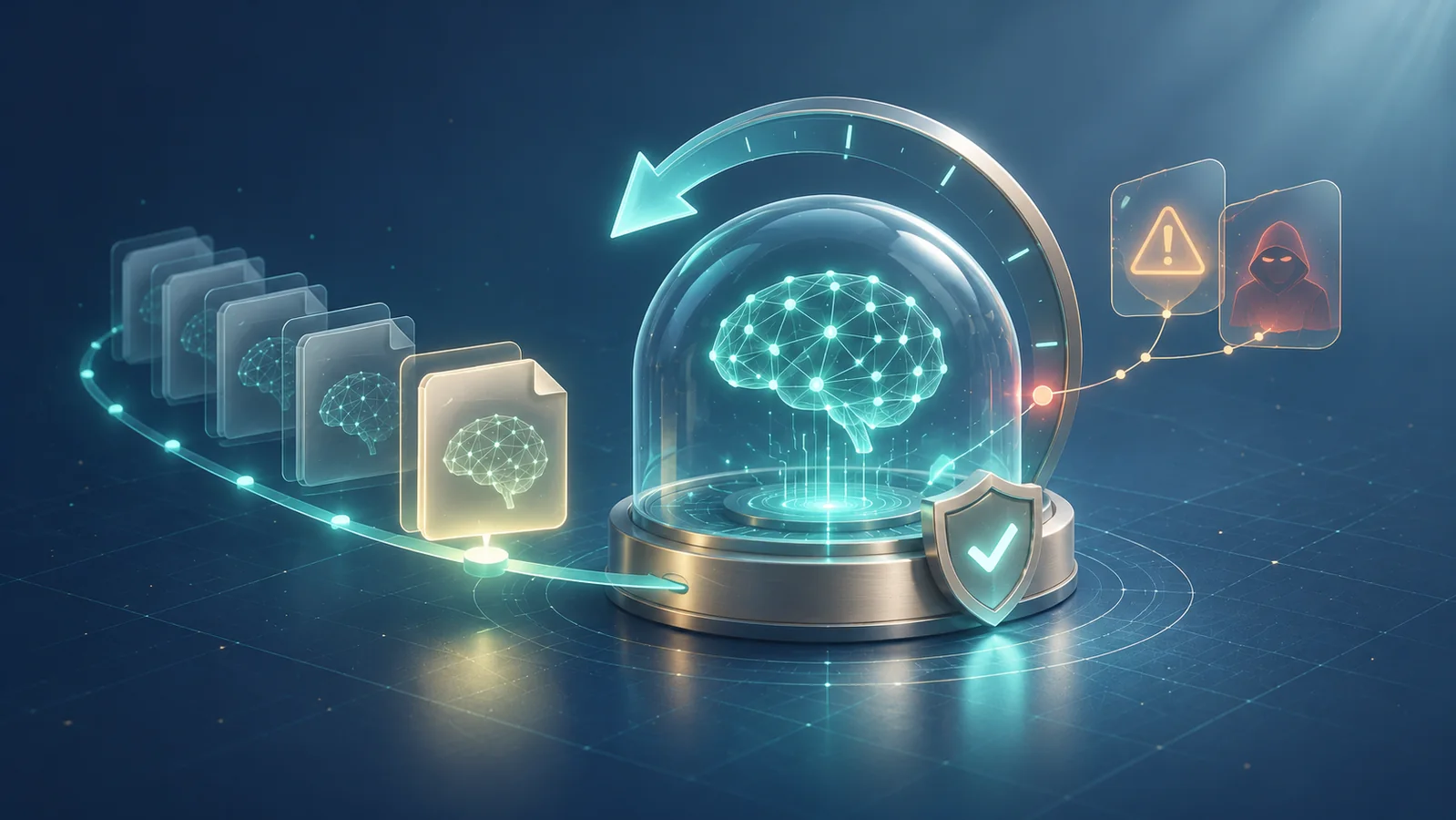
Artificial intelligence (AI) platforms support services such as product recommendations and real-time decision support. An outage or compromise can disrupt a service or alter the platform, affecting trust, increasing operational costs, and creating legal risks. Reliable recovery must preserve model integrity, training-pipeline consistency, service continuity, and regulatory compliance. CIOs, CISOs, DevSecOps teams, and decision-makers need practices, architectures, and processes that help them plan, execute, and validate recovery.
Introduction: An Increasingly Common Scenario
Imagine a start-up specialising in automated marketing content generation. One evening, the team discovers that the servers hosting the text generation model are inaccessible; logs show traces of ransomware and several recent snapshots have disappeared. Customer service is already reporting negative feedback: scheduled campaigns can no longer be published. Management must decide quickly: should they attempt a restoration from a backup, or rebuild the model from scratch?
This type of incident – whether technical failure, human error, or targeted attack – is no longer marginal. According to NIST Special Publication 800-34 Rev. 1 (Contingency Planning Guide for Federal Information Systems), organisations heavily reliant on AI are seeing their continuity requirements intensify, from both an operational and regulatory perspective (GDPR, ISO/IEC 27001). The difficulty lies in the fact that AI platforms are not simple databases: they combine massive datasets, trained models, inference pipelines, and often a hybrid infrastructure (public cloud, on-premise, edge).
Restoring such an ecosystem therefore involves:
- Reconstituting the exact state of the model (weights, hyperparameters, framework version);
- Ensuring the consistency of training data and metadata;
- Reactivating inference services without reintroducing vulnerabilities;
- Documenting the process to meet audit requirements.
Recovery must also account for the limitations of these principles, architectures, and procedures, as well as their associated points of vigilance.
1. Incident Typology: Failure vs Compromise
| Incident Type | Primary Origin | Typical Consequences | Restoration Priority |
|---|---|---|---|
| Hardware failure (disk, server) | Physical failure or capacity saturation | Immediate unavailability, partial data loss if no replication is in place | High – rapid recovery to minimise downtime |
| Software / configuration error | Code bug, untested update, incorrect CI/CD pipeline parameterisation | Progressive degradation or abrupt shutdown, version inconsistencies | Variable – requires validation of the fix before returning to production |
| Compromise (malware, ransomware, injection) | External attack, insider threat, supply chain | Loss of model/data integrity, potential leak of sensitive information | Critical – restoration must guarantee the absence of malicious persistence |
| Natural disaster / site outage | Fire, flood, massive power failure | Total unavailability of the datacenter or cloud region | Very high – geographically distributed recovery plans are essential |
These categories are not mutually exclusive: an outage may be exacerbated by an attack that leverages the chaos to inject malicious code. The first step of a restoration strategy is therefore to identify the exact nature of the incident in order to select the appropriate procedures (e.g., network isolation prior to backup, integrity validation of artefacts).
2. Fundamental resilience principles for AI platforms
2.1 AI-adapted continuity planning (BC/DR)
- ISO/IEC 27031 recommends treating ICT service continuity as an iterative process, including the definition of a target service level (RTO/RPO) for each critical component. For an AI platform, the key indicators are:
- RTO (Recovery Time Objective): maximum acceptable delay before the model can respond to requests again (often measured in minutes or hours).
- RPO (Recovery Point Objective): maximum acceptable loss of training data or metadata (generally expressed as a number of versions or days).
- Asset segmentation – separating model artefacts, the data store, and the inference infrastructure. This separation facilitates selective restoration and limits the impact surface.
2.2 Redundancy and Replication
- Multi-zone / multi-region: leverage native cloud provider replication capabilities (AWS S3 Cross-Region Replication, Azure Geo-Redundant Storage) to store model snapshots and datasets.
- Immutable backup: use solutions that render objects unmodifiable for a defined period (e.g., Amazon S3 Object Lock, Google Cloud Archive). This protects against malicious deletion or modification.
2.3 Model Lifecycle Management (ModelOps)
- Systematic versioning – every training run produces a versioned artefact in a registry (MLflow Model Registry, AWS SageMaker Model Registry). The registry must be auditable and integrated into the CI/CD pipeline to ensure that metadata (hyperparameters, dataset hash) is preserved.
- Integrity control – calculate and store checksums (SHA-256) for each artefact as well as for the source dataset. In the event of restoration, these checksums allow verification that no alteration has occurred.
2.4 DevSecOps Orchestration for Recovery
- Infrastructure as Code (IaC) – describe the entire infrastructure (networking, compute, storage) using Terraform or CloudFormation to ensure reconstruction is automated and reproducible.
- Restoration pipelines – integrate dedicated jobs into GitLab CI/CD or Azure Pipelines which, triggered by an incident event, restore artefacts from the registry, provision the infrastructure, and perform validation tests.
3. Recovery Architecture: Backup & Snapshot Strategies
3.1 Training Data Backup Level
| Level | Content | Typical frequency | Method |
|---|---|---|---|
| Full snapshot | File system containing raw datasets + metadata | Daily (or at each major iteration) | Block-level snapshots on EBS volumes, Azure Managed Disks or distributed file systems (HDFS) |
| Incremental log | Change logs (Delta) since the last full snapshot | Hourly | Object replication services (AWS S3 Inventory + Lambda) |
| Immutable archiving | Final version of a dataset used for production | For each certified version of the model | Write-Once-Read-Many (WORM) storage on Glacier Deep Archive, Azure Blob Storage Cool tier with locking |
3.2 Backup of models and pipelines
- Model Registry – each artefact is stored in a dedicated repository (e.g., MLflow, SageMaker Model Registry) with enriched metadata (framework, Python version, required GPU). The registry exposes a REST API to facilitate automated retrieval.
- CI/CD pipeline export – export pipeline definitions (YAML) and training scripts into a separate Git repository, ensuring the entire process can be restarted from scratch.
3.3 Restoration orchestration
A typical automated workflow schema:
- Trigger – an alert from the SIEM or monitoring system (e.g., Prometheus + Alertmanager) indicates a critical incident.
- Isolation – the Ansible playbook disables compromised endpoints and creates a quarantine network.
- Integrity validation – the checksum-verify job compares the SHA-256 of stored artefacts against expected values.
- IaC provisioning – Terraform deploys an identical stack (VPC, subnets, Kubernetes clusters).
- Data restoration – a restore-data.sh script retrieves snapshots and applies them to the target volume.
- Model deployment – via the registry, the versioned model is loaded into the inference service (SageMaker Endpoint, KFServing).
- Smoke tests – a smoke-test job sends inference requests using a test set and compares the responses against expected metrics.
- Traffic cutover – the load balancer switches traffic to the new instance following validation.
This fully codified pipeline reduces the Mean Time to Recovery (MTTR) to a few dozen minutes in well-prepared environments.
4. Model and data lifecycle management
4.1 Dataset traceability
Data Lineage must be recorded: each dataset version is associated with a unique identifier, its source (extraction, transformation), and an expiry date. Tools such as Apache Atlas or Google Cloud Data Catalog enable the visualisation of dependencies between datasets, ETL pipelines, and models.
4.2 Semantic versioning of models
Adopt Semantic Versioning (MAJOR.MINOR.PATCH) for model artefacts:
- MAJOR: change in architecture or framework (e.g., migrating from TensorFlow 1.x to 2.x).
- MINOR: performance improvement without API breaking changes.
- PATCH: bug fixes or dependency updates.
This convention simplifies the restoration decision process: if the compromised model is version 2.3.0 and the last reliable backup is 2.2.4, the impacts of a rollback must be analysed before proceeding.
4.3 Secrets and Access Management
API keys, database access tokens, or TLS certificates are stored in a Secret Manager (AWS Secrets Manager, HashiCorp Vault). During restoration, the playbook retrieves previous versions of secrets to prevent the reuse of already compromised credentials.
5. DevSecOps Orchestration for Automated Restoration
5.1 Security as Code Integration
The Shift-Left principle also applies to recovery: security policies (e.g., IAM, network ACL) are defined in versioned files and applied via Terraform or Pulumi. Consequently, when a stack is recreated, it automatically inherits the approved access controls.
5.2 Post-Restoration Compliance Testing
Following deployment, a Compliance Scan job (e.g., AWS Config Rules, Azure Policy) verifies that the new infrastructure adheres to regulatory requirements (GDPR, ISO/IEC 27001). In the event of a discrepancy, the pipeline immediately alerts and blocks production deployment.
5.3 Incident Management via Runbooks
Runbooks are stored in a GitOps repository (e.g., Argo CD, Flux) and contain:
- The step-by-step sequence of actions,
- The cutover criteria (test validation, manual approval),
- The escalation contacts.
Their continuous update ensures that procedures remain aligned with the evolution of the infrastructure.
6. Incident response procedures – investigation, containment, restoration
6.1 Investigation phase
- Log collection: aggregation via ELK Stack or Splunk to obtain traces from the inference server, the model registry, and the storage system.
- Forensic analysis – calculate binary file hashes and compare them with values stored in the registry. In case of discrepancy, identify the entry point (e.g., exploited CVE-2023-XXXXX vulnerability).
6.2 Containment
- Network isolation of the compromised node,
- Secret rotation via the Secret Manager,
- Blocking accounts exhibiting abnormal behaviour (anomaly detection via UEBA).
6.3 Restoration
Follow the automated workflow described in section 3, while adhering to the following points:
| Action | Rationale |
|---|---|
| Checksum re-validation of models | To ensure the absence of backdoors or trojans injected into the network weights. |
| Partial retraining with non-compromised data | If corruption affects the dataset, infected samples must be removed to prevent the model from reproducing a malicious bias. |
| API integrity testing (OpenAPI contract) | To ensure that the interface has not been modified (e.g., addition of hidden parameters). |
6.4 Feedback and continuous improvement
Following the return to service, conduct a structured post-mortem using the 5 Whys model to identify root causes and update the continuity plan (adding backup points, strengthening access controls).
7. Use case: restoration of a text generation platform after ransomware
Context
A French SME provides a SaaS API that automatically generates product descriptions in French and English. The service relies on:
- A Kubernetes cluster (EKS) hosting the inference micro-services,
- An MLflow model registry stored in a versioned S3 bucket,
- A data lake containing training corpora (≈ 500 GB),
- A PostgreSQL database for client request persistence.
Incident
On 12 March 2024, the SOC detects ransomware activity on the data lake storage node. The malware encrypts several S3 objects not protected by Object Lock. EBS snapshots associated with the cluster are also deleted via a malicious script executed using compromised credentials.
Restoration Action
| Step | Detailed Description |
|---|---|
| 1 Isolation | The Ansible playbook disables the S3 VPC endpoint, revokes compromised IAM keys, and blocks the source IP address of the malicious traffic. |
| 2 Integrity Verification | SHA-256 checksums of the models in the MLflow registry are compared against expected values; no models have been altered. |
| 3 Data Lake Restoration | Utilisation of cross-region replication (S3 bucket us-east-1 → eu-west-1) which has preserved objects in immutable mode since March 10th. The dataset is rehydrated onto a new bucket with Object Lock enabled. |
| 4 Cluster Reconstruction | Terraform recreates the EKS infrastructure within the same region, applying IAM policies based on the principle of least privilege. |
| 5 Model Deployment | The CI/CD pipeline retrieves