
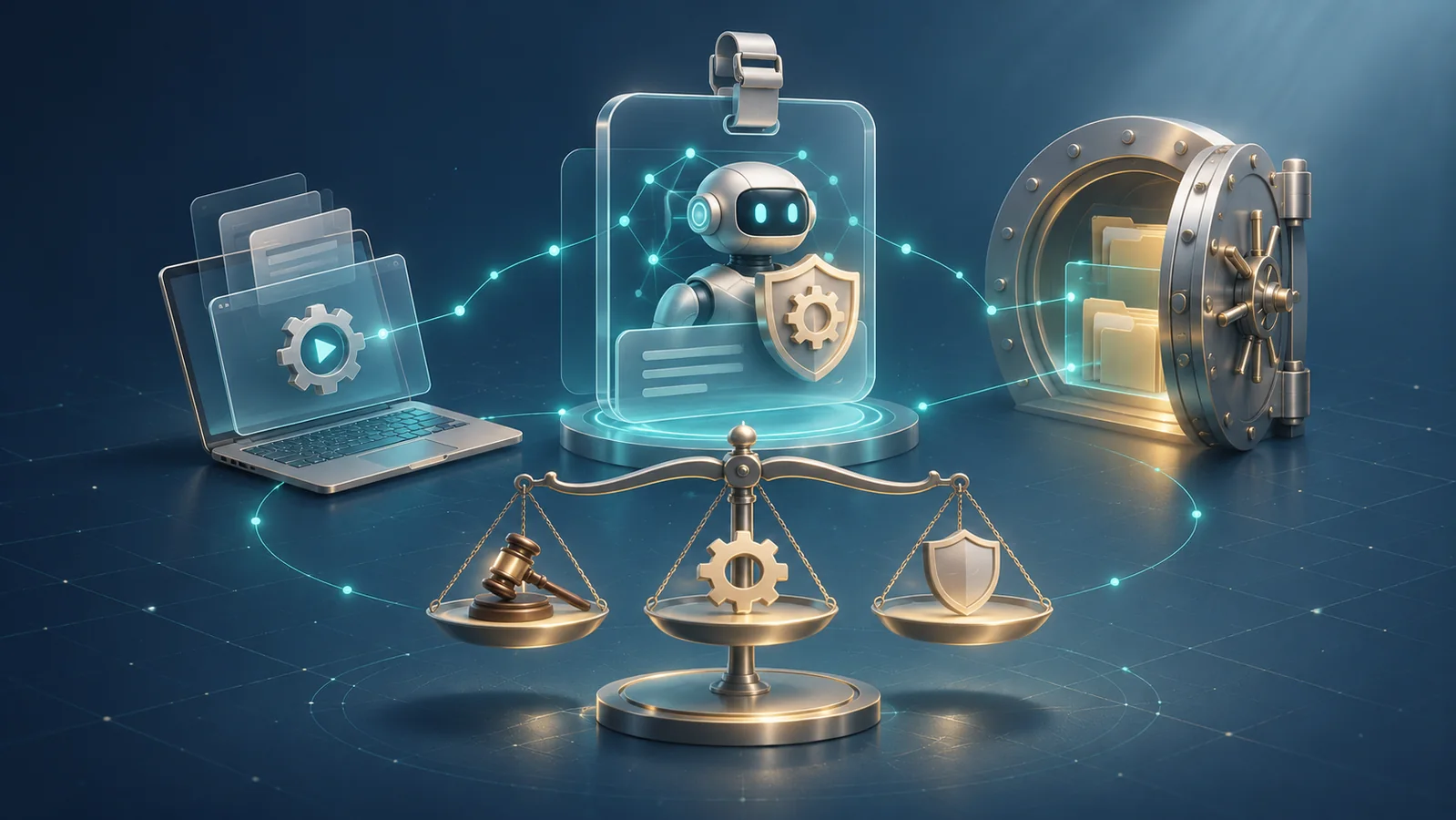
The emergence of intelligent agents capable of executing automated tasks at a system-wide scale is prompting organisations to grant them machine identities with elevated rights, or even administrator access. This raises the question of who bears legal, operational, and security responsibility when an agent causes damage or makes an error. The article covers machine identity frameworks, governance models, the risks of using AI with administrator privileges, legal requirements (GDPR, NIS2, ISO/IEC 27001…), and best practices for assigning, controlling, and auditing these rights. It is aimed at executives, CIOs, CISOs, and compliance officers, and maps responsibilities and mitigation measures.
Introduction
Imagine a cloud orchestration platform where an AI agent analyses load metrics in real time, automatically triggers the provisioning of new instances, and applies security patches. To enable this agent to operate seamlessly, it is assigned the machine identity ia‑orchestrator@prod with administrator privileges on the cloud service account (e.g., IAM Role AdministratorAccess). Two months later, a misinterpretation of a metric leads to the accidental deletion of a critical data volume, resulting in production downtime and the loss of customer records.
Who is legally liable? The developer who programmed the algorithm? The DevSecOps team that granted the access rights? The cloud provider for a potential failure of the identity service? Or the company itself, acting as the 'data controller'?
These scenarios are no longer hypothetical. The combination of AI automation and elevated privileges creates a new liability vector that requires explicit governance, both technical (access control, traceability) and legal (assignment of roles). We will therefore explore:
- The nature of machine identities and privilege assignment mechanisms.
- Relevant regulatory frameworks (GDPR, NIS2, ISO/IEC 27001, PCI‑DSS, etc.).
- The shared responsibility model between developers, operational teams, and management.
- Best practices for design, auditing, and incident response.
1 Machine Identities: Concepts and Assignment Mechanisms
1.1 Definition and Typology
| Identity Type | Description | Usage Example |
|---|---|---|
| Service account | A non-human identity used by automated processes. It typically possesses a password or private key stored within a secret manager. | svc-backup@corp executing nightly backups. |
| Application role | An IAM role assigned to an application via OpenID Connect / OAuth 2.0, often restricted to specific scopes. | read-only-db role for a reporting microservice. |
| AI-managed identity | An identity created dynamically by an AI orchestrator that adjusts permissions based on context (e.g., AI Auto-Scaling). | ai-orchestrator@prod with temporary administrator privileges. |
| Container identity | A JWT token issued to each Kubernetes pod via the SPIFFE/SPIRE project, enabling access to internal APIs. | pod-1234 accessing the internal image registry. |
These identities are typically managed by Identity and Access Management (IAM) systems: AWS IAM, Azure AD, Google Cloud IAM, or third-party solutions (HashiCorp Vault, CyberArk).
1.2 Assignment of Administrator Privileges
Granting 'admin' rights to a machine identity relies on two mechanisms:
| Trigger | Method | Primary Risk |
|---|---|---|
| Explicit Privilege | Direct addition of an AdministratorAccess policy. | Over-provisioning, expanded attack surface. |
| Dynamic Elevation (Just-In-Time) | An AI engine issues a short-lived token following contextual verification (e.g., risk analysis). | Evaluation engine failure → unauthorised elevation. |
Best practices recommend the principle of least privilege and just-in-time access to reduce exposure.
1.3 Traceability and Auditability
- IAM Logs: every token issuance, renewal, or revocation must be logged with the following metadata: initiating identity, context (IP, service), duration, and justification.
- Chain of Trust: use of digital signatures (e.g., AWS STS signed tokens) to guarantee token integrity.
- Retention: logs must be retained for at least 12 months in accordance with ISO/IEC 27001 A.12.4.
2 Legal and Regulatory Framework
2.1 Responsibility of the Data Controller (GDPR)
The General Data Protection Regulation requires the data controller to ensure the security of processing, including access management [1]. When an AI agent acts with administrative privileges and causes a data breach, the controller remains primarily responsible, unless it can be proven that the incident resulted from a fault of the processor (Article 28).
Implications:
- Obligation to conduct a Data Protection Impact Assessment (DPIA) before deploying an AI agent with elevated privileges.
- Requirement to document technical and organisational measures (e.g., access controls, periodic reviews).
2.2 NIS2 Directive and Cybersecurity Requirements
The European NIS2 directive expands the scope of obligations to essential service providers, including cloud operators and AI platforms [2]. It mandates:
- Risk management: identification of attack vectors related to machine identities.
- Reporting: mandatory notification of major incidents within 24 hours.
- Shared responsibility: the cloud service provider must provide an IAM compliance report, while the client organisation remains responsible for configuration management.
2.3 ISO/IEC 27001 and 27701 Standards
- ISO/IEC 27001 A.9 (access control) recommends the separation of rights between humans and machines, as well as regular permission reviews.
- ISO/IEC 27701 (privacy extension) specifies that automated decision-making processes must be documented, which includes high-privileged AI agents.
2.4 Contractual liability and insurance
Cloud service agreements (SLA) often include limitation of liability clauses; however, recent case law (e.g., Google Cloud vs. Company X, 2023) shows that courts may hold the client liable if the granting of administrator rights to an AI was not subject to due diligence.
Cyber-risk insurance generally covers remediation costs and business interruption, but excludes damages resulting from inadequate governance practices (e.g., lack of privilege reviews). It is therefore crucial to align IAM policy with the insurer's requirements.
3 Shared responsibility model
| Level | Primary Actor | Key Responsibilities |
|---|---|---|
| Strategy & Governance | Management (CISO, CTO) | Define machine identity policy, approve privilege models, and ensure regulatory monitoring. |
| Design & Development | DevSecOps / AI Teams | Implement least privilege, integrate validation controls (e.g., policy-as-code), and code Just-In-Time elevation mechanisms. |
| Operations & Maintenance | Cloud Administrators / SRE | Manage secret rotation, monitor IAM logs, and perform periodic (quarterly) reviews. |
| Audit & Compliance | CISO / DPO | Verify traceability, perform targeted penetration testing on AI accounts, and ensure compliance with the DPIA. |
| Crisis Management | Incident Response Team | In the event of an incident, rapidly identify the affected machine identity, revoke tokens, and analyse the AI decision chain. |
3.1 Example RACI matrix
| Tâche                                   | Responsable (R) | Autorité (A) | Consulté (C)      | Informé (I) |
|----------------------------------------|------------------|--------------|-------------------|-------------|
| Définition du modèle de privilèges IA  | CTO, CISO        | CEO          | DPO, Juristes     | Toutes les équipes |
| Implémentation du moteur d’élévation    | Lead AI Engineer | CISO         | SRE, Security Ops | DevOps      |
| Revue trimestrielle des droits admin   | IAM Manager       | CISO         | Auditeur interne  | Direction  |
| Analyse post‑incident IA                | Incident Lead    | CISO         | DPO, Juristes     | Toutes les équipes |
This matrix clarifies who holds decision-making authority and who is accountable in the event of a failure.
4 Specific risks associated with high-privileged AI agents
| Risk | Description | Potential impact | Mitigation methods |
|---|---|---|---|
| Algorithmic logic error | The AI makes a decision based on erroneous data (e.g., corrupted metrics). | Unauthorised deletion or modification of critical resources. | Cross-validation with static rules, A/B testing in a canary environment. |
| Privilege escalation | The AI exploits a vulnerability in the authorisation engine to obtain elevated rights. | Full access to the internal network, data exfiltration. | Sandboxing of the AI engine, security code audits (SAST/DAST). |
| Machine secret compromise | Theft of a private key or token from an admin account. | Total takeover by a malicious actor. | Automated secrets rotation (e.g., AWS Secrets Manager), encryption at rest, MFA for critical actions. |
| Decision bias | The AI prioritises certain resources over others, creating load imbalances. | Service degradation, SLA breach. | Monitoring of fairness KPIs, periodic human-in-the-loop review. |
| Regulatory non-compliance | Lack of documentation regarding automated decisions. | GDPR/NIS2 sanctions, fines up to 4% of annual turnover. | DPIA, AI processing register, 'model card' documentation. |
5 Reference architecture for an AI agent with administrative privileges
+----------------------+      +-----------------------+
|   Orchestrateur IA   | ---> |  IAM Policy Engine    |
| (ex. OpenAI‑GPT‑4)  |      | (policy‑as‑code)      |
+----------+-----------+      +----------+------------+
           |                               |
           | JWT (scoped, short‑lived)     |
           v                               v
+----------------------+      +-----------------------+
|  Service Mesh (SPIRE)| ---> |  Cloud Provider IAM   |
|  (mutual TLS)       |      | (role delegation)    |
+----------+-----------+      +----------+------------+
           |                               |
           | API Calls with token          |
           v                               v
+----------------------+      +-----------------------+
|  Micro‑services /    | ---> |  Ressources Cloud     |
|  fonctions serverless|      | (VM, DB, Storage)    |
+----------------------+ +-----------------------+- Policy Engine: defines access rules as code (OPA/Rego).
- Just-In-Time Token Service: issues JWTs valid for 5–15 minutes, including the contextual risk score.
- Service Mesh (SPIRE): ensures mutual authentication between micro-services and prevents token spoofing.
This architecture enables:
- Isolation – each component possesses only the permissions necessary for its immediate role.
- Auditability – every access request generates a structured log (identity, risk score, decision).
- Reversibility – token revocation results in the instantaneous invalidation of privileges.
6 Realistic use case: security patch automation
Context
A large European bank operates a data lake hosted on Azure. An AI agent, ai‑patcher@prod, daily analyses CVE bulletins and automatically triggers the application of critical patches on Windows Server virtual machines. To prevent any service interruption, the account holds the Owner role for the relevant resource group.
Workflow
| Step | Action | AI Decision | Privilege used |
|---|---|---|---|
| 1 | CVE feed retrieval (NVD) | Filtering by severity ≥ 9.0 | None (public read) |
| 2 | Impact analysis via CMDB | Identifies 12 critical VMs | Token read‑only‑cmdb (10 min) |
| 3 | Reboot scheduling | Verifies maintenance window | Token scheduler‑write (5 min) |
| 4 | Patch deployment | Executes PowerShell script via Azure Automation | Role Owner on the resource group (15 min) |
| 5 | Post-deployment validation | Verifies service status | Token monitor‑read (5 min) |
Simulated incident
A bug in the impact logic misclassified two VMs as non-critical. The patch was applied during a period of high activity, causing an unintended reboot and temporary loss of customer service (SLA 99.9%).
Accountability analysis
| Actor | Single points of failure | Legal liability |
|---|---|---|
| AI Developers | Erroneous impact algorithm (bug) | Shared responsibility – design flaw; may be considered professional negligence. |
| DevSecOps Team | Assignment of Owner role without temporal justification | Direct liability – violation of the principle of least privilege, therefore non-compliance with GDPR/NIS2. |
| Management (CISO) | Lack of human validation for critical patches | Hierarchical responsibility – failure to meet supervision obligations. |
| Cloud Provider (Azure) | No flaws identified in the IAM service | No direct liability, unless a token isolation issue is demonstrated. |
Lessons learned
- Implement mandatory human validation for any fix impacting high-criticality services.
- Restrict the Owner role to a Just-In-Time token limited to 5 minutes, with real-time auditing.
- Add an AI regression test before each update of the impact engine.
7 Points of vigilance
7.1 Machine identity governance
| Aspect | Key question | Best practices |
|---|---|---|
| Provisioning | Who approves the creation of an AI identity? | Automated workflow with manual approval (e.g., ServiceNow). |
| Lifespan | Are accounts disabled when no longer in use? | Automatic rotation every 30 days, deletion after inactivity > 90 days. |
| Segmentation | Are permissions limited to a functional scope (VPC, project)? | Use dedicated resource groups or namespaces. |
| Auditability | Are IAM logs centralised and protected against modification? | SIEM with immutability (e.g., Azure Sentinel + WORM). |
7.2 Technical controls
- Policy-as-code (OPA, AWS IAM Access Analyzer) – versioning access policies in Git and implementing code reviews.
- Secret Management – storing private keys in a vault (HashiCorp Vault, Azure Key Vault) with automated rotation.
- MFA for critical actions – requiring a second factor even for AI tokens when an elevation exceeds a threshold of