
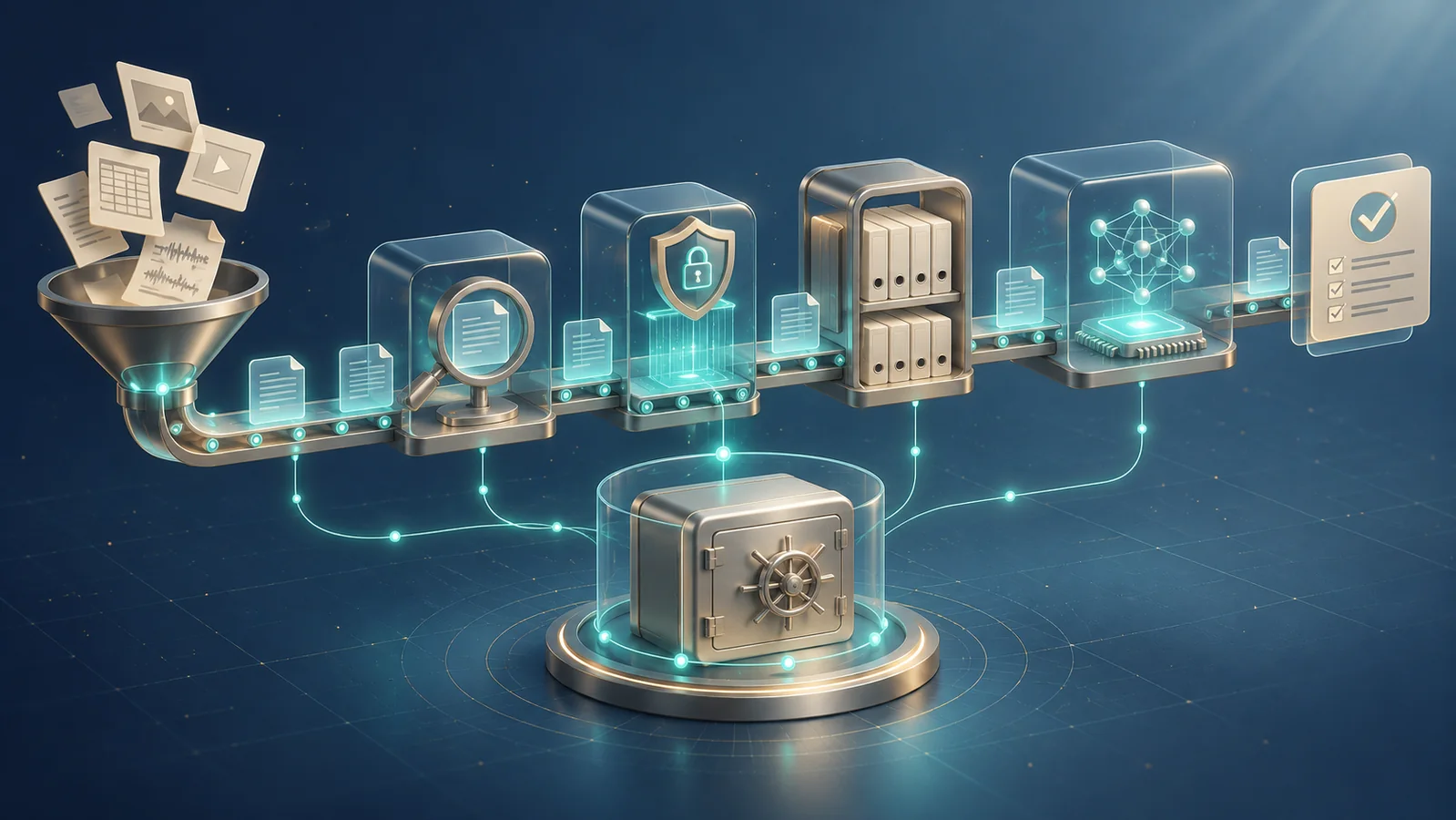
Artificial intelligence (AI) algorithms drive an increasing share of business processes. Collecting raw data is not enough: organisations must be able to trace, secure, and preserve each piece of data throughout its lifecycle to guarantee model reliability, regulatory compliance, and operational resilience. A complete chain of custody addresses technical, legal, and organisational requirements, integrates with DevSecOps and MLOps, and gives decision-makers a concrete roadmap.
Introduction: from sensor noise to automated decision-making
Imagine an insurance company aiming to detect automotive claims fraud in real time. IoT sensors, server logs, contract histories, and satellite imagery are ingested every second. Without a mechanism capable of guaranteeing that every piece of data has been correctly captured, stored, enriched, versioned, and linked to its original context, the detection model risks learning from erroneous or untraceable information: bias, non-compliance (GDPR), and operational failures then become inevitable.
The complete chain of custody — sometimes referred to as end-to-end data lineage — addresses this need by ensuring the traceability, integrity, governance, and availability of every data point from its source to its utilisation by decision-making algorithms. This framework is no longer a 'nice to have'; it has become a sine qua non for:
- complying with the traceability requirements of GDPR (Article 30) and industry standards (e.g., ISO 26262 for automotive);
- guaranteeing the quality of training sets, thereby limiting bias and model drift;
- providing a solid foundation for MLOps/DevSecOps practices, where every software artefact and dataset must be versioned and auditable;
- ensuring resilience against incidents (data corruption, ransomware) through proven backup and archiving strategies.
Before starting a project, organisations should assess the chain’s technical components, regulatory requirements, expected benefits, and limitations.
1. Definition and Scope of a Complete Chain of Custody
| Concept | Description | Concrete Example |
|---|---|---|
| Ingestion | Capture of raw data from sources (sensors, external databases, APIs) with immutable timestamping. | Kafka streams ingesting web access logs. |
| Persistent storage | Long-term retention in systems guaranteeing non-alteration (WORM, immutable storage). | Azure Blob Storage in immutable mode for 7 years. |
| Metadata & catalogue | Recording of context (provenance, schema, owner, sensitivity level). | Apache Atlas describing the 'transactions-paiement' flow. |
| Transformation / enrichment | Versioned ETL/ELT operations generating derivatives (features, aggregates). | Spark job calculating risk scores from logs. |
| Versioning & access control | Every dataset and software artefact is immutable and subject to an RBAC policy. | Git-LFS for training sets, fine-grained IAM on GCP. |
| Archiving & retention | Retention policy aligned with legal requirements (e.g., 5 years for financial data). | S3 Object Lock policy with a 10-year retention period. |
| Audit & traceability | Full 'who-what-when-why' logging enabling the reconstruction of a flow. | CloudTrail logs + DataDog trace of Airflow pipelines. |
Note: The chain does not end at the modelling stage; it continues through to the automated decision (inference) and, where applicable, feedback to the source data.
2. Regulatory challenges and data governance
2.1 Traceability mandated by GDPR and CCPA
- GDPR Art. 30: Obligation to maintain a record of processing activities, including the description of data flows and the security measures applied.
- CCPA (California Consumer Privacy Act): Requires the ability to respond to access or deletion requests within 45 days, necessitating precise localisation of data copies.
2.2 Industry Standards
| Sector | Reference | Key Obligation |
|---|---|---|
| Finance (Basel III) | BCBS‑239 | Data risk management and full traceability of reports. |
| Healthcare | HIPAA §164.312(b) | Access logging for electronic medical records. |
| Automotive | ISO 26262 | Retention of functional test data for functional safety. |
2.3 Governance and Accountability
A complete chain enables the implementation of a RACI (Responsible, Accountable, Consulted, Informed) matrix at the data asset level, thereby facilitating internal and external audits. The establishment of a Data Stewardship Council is often recommended to ensure ongoing compliance.
3. Technical architecture of a retention chain
3.1 Global schematic (Cloud-native example)

Read the diagram notation
graph LR
    A[Sources] -->|Kafka| B[Ingestion Layer]
    B --> C["Data Lake (Immutable S3)"]
    C --> D["Catalogue Métadonnées (Apache Atlas)"]
    D --> E["Processing (Spark, Flink)"]
    E --> F["Feature Store (Hopsworks)"]
    F --> G["Model Training (MLflow)"]
    G --> H[Model Registry]
    H --> I["Inference Service (KServe)"]
    I --> J[Decision Engine]
    subgraph Audit
        K["Log Management (ELK)"]
        L["Traceability (OpenTelemetry)"]
    end
    B-->K; E-->L; I-->K;
3.2 Key components
| Level | Common tools | Role |
|---|---|---|
| Ingestion | Apache Kafka, AWS Kinesis, Azure Event Hubs | Reliable and scalable capture of real-time streams. |
| Immutable storage | Amazon S3 Object Lock, Google Cloud Storage Retention Policy, Azure Immutable Blob | Ensures that data cannot be modified or deleted before the end of the retention period. |
| Catalogue & metadata | Apache Atlas, Amundsen, DataHub | Centralises the data dictionary, facilitating data discovery and dependency tracking. |
| Transformation | Apache Spark, Flink, dbt (Data Build Tool) | Executes versioned ETL/ELT jobs; every transformation is traceable via Git. |
| Feature Store | Hopsworks, Feast | Maintains ready-to-use feature sets and ensures consistency between training and inference. |
| MLOps | MLflow, Kubeflow Pipelines, DVC (Data Version Control) | Orchestration of the full model-data lifecycle and artifact versioning. |
| Security & Compliance | HashiCorp Vault (secrets), Cloud IAM, Azure Purview | Centralised access management and encryption at rest/in transit. |
| Audit & Observability | Elastic Stack, Splunk, OpenTelemetry, Prometheus | Collects logs, metrics, and traces for flow reconstruction. |
3.3 DevSecOps Integration
- Infrastructure as Code (IaC): Terraform/CloudFormation defines immutable storage and IAM policies, ensuring reproducibility.
- CI/CD Pipeline: Every modification to the ingestion pipeline triggers compliance tests (e.g., schema verification via Great Expectations).
- Security Scanning: SAST/DAST applied to ETL scripts; automated secrets scanning using git-secret or TruffleHog.
4. Data Quality and Bias Mitigation
4.1 Roles of a complete data quality chain
| Dimension | Control Method |
|---|---|
| Accuracy | Schema validation, domain constraints (e.g., postcode values). |
| Completeness | Data freshness dashboards; alerts on ingestion gaps. |
| Consistency | Cross-reference checks between sources (e.g., CRM vs ERP customer matching). |
| Temporality | Immutable timestamping, management of late-arriving data. |
4.2 Model bias and drift
Through traceability, it is possible to:
- Identify distribution changes (data drift) by comparing the statistics of the initial training set with those of the production stream (e.g., Kolmogorov–Smirnov).
- Reconstruct the complete pipeline that generated an incriminating feature set, in order to rapidly correct the source of the bias.
5. Security, privacy and resilience
5.1 Encryption & access control
- Encryption at rest: AES-256 managed by the cloud provider (e.g., AWS KMS).
- Encryption in transit: TLS 1.3 between Kafka, Spark and storage components.
- Zero-Trust IAM: Least privilege principles via attribute-based policies (e.g., ABAC).
5.2 Incident management
| Scenario | Response Method |
|---|---|
| Data lake segment corruption | Use of WORM + restoration from immutable snapshots. |
| Ransomware targeting the metadata catalogue | Git versioning of the atlas‑config.yaml file; rapid rollback. |
| Sensitive data leak | DLP (Data Loss Prevention) integrated into the ingestion pipeline, dynamic masking. |
5.3 Compliance with security standards
- NIST SP 800‑53 Rev 5 – Control AU‑12 (audit log generation).
- ISO/IEC 27001 – Annex A.12.4 (protection against malware) applied to the Spark cluster.
6. Use case: real-time automotive fraud detection
6.1 Business Context
A motor insurance company aims to reduce the average processing time for fraudulent claims from 48 hours to under 5 minutes.
6.2 Implemented Architecture
| Step | Technical Description |
|---|---|
| Ingestion | Telematics sensors (CAN-bus) → Kafka topic telemetry (partitioned by VIN). |
| Storage | Raw data in S3 with Object Lock 7 years; metadata recorded in DataHub. |
| Enrichment | Spark streaming calculates average speed, harsh braking, and performs a join with the claims registry (PostgreSQL). |
| Feature Store | Feast exposes the speed_variance and hard_brake_count features to the models. |
| Modelling | XGBoost trained via MLflow, version v3.2, with hyperparameters stored in the registry. |
| Inference | KServe deploys the model in canary mode; scores are returned to the decision platform. |
| Decision Engine | Business rule: score > 0.85 → fraud-high alert; workflow orchestrated by Camunda. |
| Audit & Traceability | OpenTelemetry traces every pipeline call, logs aggregated in Elastic; Grafana dashboard for SLA (≤ 5 min). |
6.3 Observed Benefits
- Reduction in detection time: from 48h to 4 min (99% improvement).
- GDPR compliance: each piece of telematics data is linked to an explicit consent stored in the catalogue, facilitating access requests.
- Resilience: following a ransomware attempt on the Spark cluster, restoration from immutable snapshots was completed within 30 minutes with zero data loss.
7. Limitations, risks and points of vigilance
7.1 Infrastructure costs and complexity
- Immutable storage leads to higher capacity costs (versions are never overwritten).
- Implementing a metadata catalogue requires a governance effort: defining schemas and training Data Stewards.
7.2 Risks associated with over-retention
Indefinite retention of sensitive data can create an additional attack surface. It is therefore necessary to apply the principle of data minimisation by combining immutable retention with automated purging once legal requirements are met.
7.3 Cloud provider lock-in
The use of proprietary services (e.g. AWS Object Lock) creates a difficult vendor lock-in. A multi-cloud strategy or the adoption of open-source tools (Ceph, MinIO) can mitigate this risk.
7.4 Change management
Any evolution of the pipeline (new schema, new source) must be declared and versioned; otherwise, traceability is broken. A robust change management process is indispensable.
Points of vigilance
- Verify that each component has a retention plan compliant with the legal requirements of the country of operation.
- Implement automated compliance tests (e.g., validation of the GDPR register via OpenPolicyAgent).
- Ensure that DevSecOps and Data Engineering teams share the same metadata repository to avoid silos.
8. Operational roadmap for implementing a chain of custody
| Phase | Key Objectives | Deliverables |
|---|---|---|
| 1 Analysis & Scoping | Mapping of sources, legal requirements, and identification of stakeholders. | Governance report, RACI matrix, GDPR/ISO 27001 compliance table. |
| 2 Target Architecture | Selection of immutable storage, metadata catalogue, ingestion pipeline. | Architecture diagram (Mermaid), IaC plan (Terraform). |
| 3 Pilot implementation | Deployment of a critical data stream (e.g., server logs) with full traceability. | CI/CD pipeline, compliance test suite, KPI dashboard. |
| 4 Extension & automation | Addition of remaining sources, integration of the feature store and MLOps. | Process documentation, automation scripts (dbt, Airflow). |
| 5 Continuous governance | Periodic audits, retention policy updates, training. | Annual audit report, training plan, data lake health dashboard. |
9. Operational conclusion
A complete chain of custody is not merely an additional technical layer; it is the vital link connecting raw data to automated decisions by guaranteeing:
- Traceability and compliance – essential for meeting the requirements of GDPR, CCPA, and industry standards.
- Model quality and reliability – clear provenance ensures that biases are detected earlier and model drift is controlled.
- Operational resilience – immutable storage and automated auditing limit the impact of incidents (ransomware, corruption).
- DevSecOps / MLOps synergy – unified versioning of data and code creates a continuous and secure feedback loop.
By investing in this infrastructure, organisations transform their data into a governable asset capable of powering AI in a responsible and sustainable manner. However, implementation requires **organisational discipline