
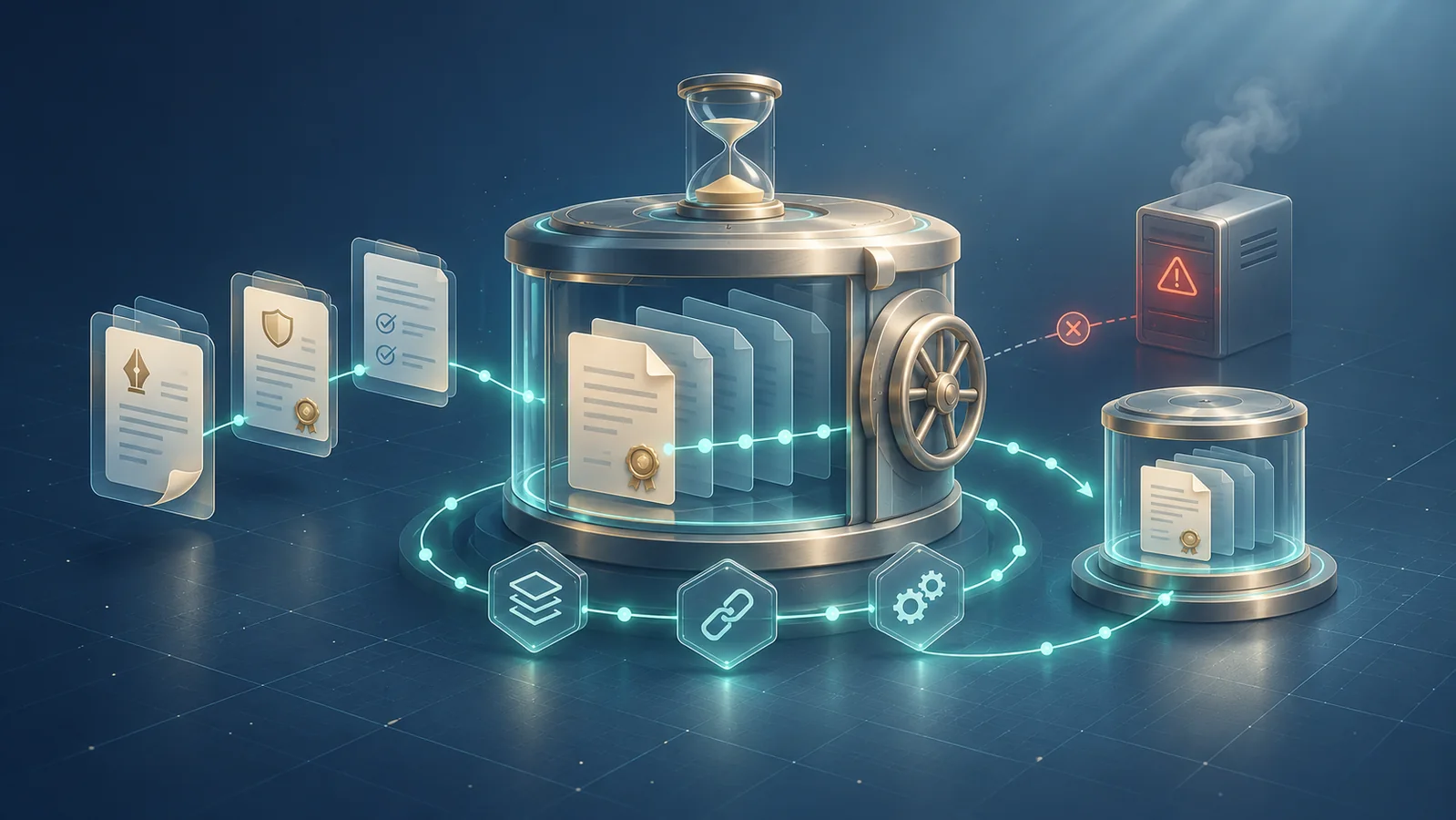
A document evolves, an authorization expires, a decision is revised. Months later, a team needs to recover the information it relied on. This is the role of KARL's Memory Layer: keeping versions, their links and the traces of operations to allow the history of governed data to be reconstructed and verified.
But this memory must also survive incidents. When a server fails or a storage becomes unreachable, the company must be able to resume operations while keeping a consistent history.
High availability for enterprise memory
KARL Core's high-availability evolutions address this need. Memory can be replicated across independent storage backends, distributed across multiple sites or providers according to the deployment. A write is validated when the number of confirmations defined by the configuration is reached. If these conditions are no longer met, the system refuses to validate new writes.
A safeguard as important as replication itself
This safeguard matters as much as replication itself. Two servers that continued making changes during a network outage could produce two incompatible histories. KARL therefore assigns writes to a single server at a time. Handover is controlled, and promoting a storage copy requires verifying that it is up to date.
Recovery leaves traces too
Gaps between copies are detected, repairs are verified and continuity operations are recorded in a signed journal. The team thus has material to understand what happened during the incident and track the return to a consistent state.
High availability extends the role of the Memory Layer: preserving the company’s ability to explain its history through changes and failures.
Read in ITRnews: StratoFoundry gives verifiable memory to enterprise data.